Hello guys, today we are going to speak about Russian endings. Let’s have a look at a couple of comments to a super funny Russian cartoon ‘Masha and the Bear’ («Маша и Медведь»). You can find it here.
Little by little we will study them and this will help you to understand Russian endings better and to speak like a native yourself!
The first one is «Очень прикольная серия». Let’s translate the words in this comment and have an attentive look at the Russian endings. The word «очень» means ‘very’, the word «прикольная» means in this case ‘cool’ or ‘funny’ and the word «серия» means ‘episode’. Now let’s have a closer look at the last two words.
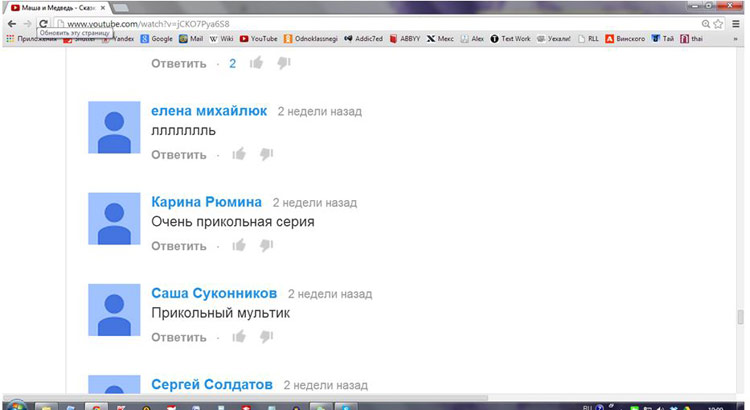
From these two comments you can learn four new Russian words and one Grammar rule.
«Прикольный» is very widely used in Russian colloquial speech. It is an adjective which shows that you are amazed or surprised about something. There are lots of synonyms for «прикольный»: ‘funny’, ‘cool’, ‘top class’, ‘great’ and so on. And when we talk about something humorous, like a movie, a cartoon or a joke, we can also say «прикольный», meaning that it’s funny.
So which one of all those meanings did the commentator use? The truth is that no one knows apart from him 🙂 . Maybe he found the cartoon funny or maybe he found it cool. I think he probably meant both.
The next word «серия» is used when we talk about some TV-shows that have several episodes. Each of them is called «серия».
Ok, the next comment is «Прикольный мультик». You already know the first word, don’t you? Notice that the last two letters in this case are different. If you don’t yet know, it’s because words in Russian never stay in one place and Russian endings are always changing! The adjectives love nouns and they are greatly dependent on them. It looks like they cannot make a single step without their nouns! Ok, let’s add some sense to that and see how Russian endings may change.
Russian endings depend on a gender. A noun in Russian can be either masculine, feminine or neutral gender.
There are quite a few rules on how to recognize them and we will learn them step by step. For now all you have to remember is that a noun which ends in «-я» is almost always feminine. Like here – the word «серия» is feminine.
And how does it influence adjectives? – you ask me, my curious student. Very simply. It influences their endings. If an adjective is connected to a noun of a feminine gender, the adjective is also feminine! Girls with girls, and boys with boys. A feminine adjective has the ending «-ая». So, a noun ends with «-я» («серия») and an adjective connected to that noun ends with «-ая» («прикольная»). Not as difficult as it seemed at first, is it?
So, let’s get back to our second comment – «Прикольный мультик». The word «мультик» is a short colloquial form of «мультфильм» — a ‘cartoon’, like saying ‘toon’.
«Мультик» is a noun. It ends with a consonant. That shows us that this noun is masculine. Do you still remember that adjectives are connected to nouns and take the same gender? Of course you remember. So you see now that masculine adjectives have the ending «-ый».
Well, ending this article I wanted to say that these Russian endings work for the base form of both nouns and adjectives. But then I changed my mind – it’s just too much for a single article, isn’t it? We wouldn’t want our heads exploding, would we?
Listen to Russian endings: ‘girls’ go with ‘girls’ and ‘boys’ with…?
Check Out For More!
 Learn how to say I adore in Russian and to recognize when Russians make a mistake with this word!
 Interesting facts about languages: what Thai has that English and Russian doesn’t
 Russian surnames meanings: goats, smiths and priests. 20 most common Russian surnames
 How to learn to read Russian: worst and best ways
 When Please in Russian means ‘Here you are!’
 9 most common Russian insults in which animal names are used
 When Yes of course in Russian means Definitely not
 3 Russian words for You and when to use each of them
No comments yet.